What Are Types of Waterproofing?
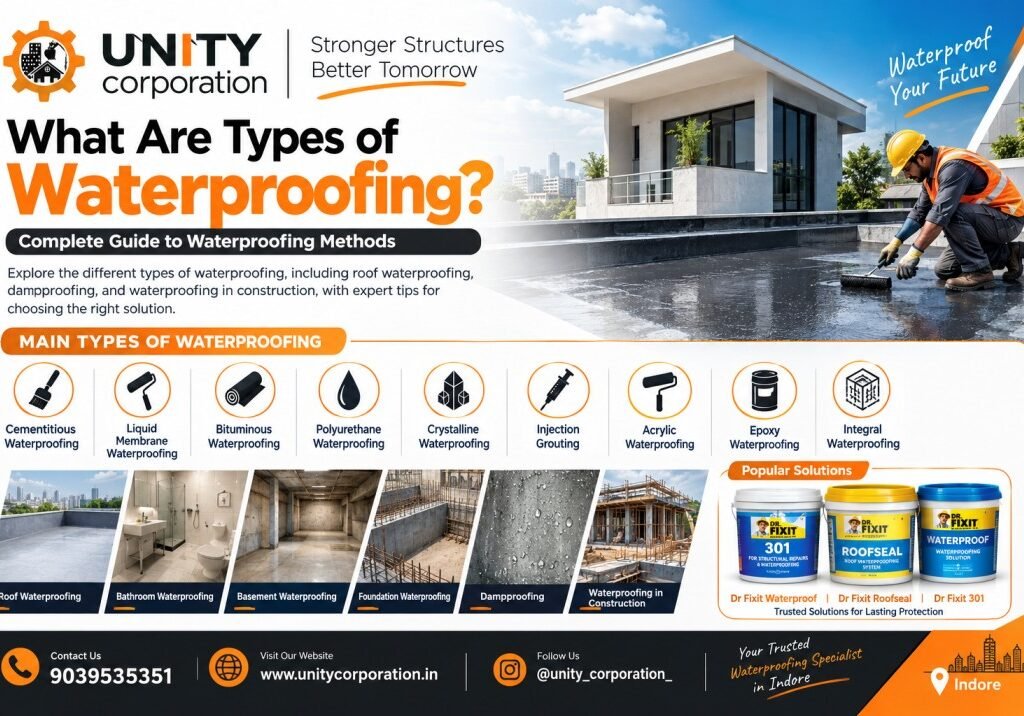
Types of waterproofing are different methods, materials, and systems used to protect buildings and structures from water penetration, moisture, dampness, and leakage. Waterproofing plays an important role in modern construction because water can damage concrete, walls, roofs, foundations, floors, and interior finishes.
Understanding the different Types of waterproofing is important before selecting a waterproofing solution. Depending on the location and type of structure, waterproofing may include cementitious waterproofing, liquid membrane waterproofing, bituminous waterproofing, polyurethane waterproofing, crystalline waterproofing, injection grouting, and other specialized systems.
In this guide, we will explain the major Types of waterproofing, including roof waterproofing, bathroom waterproofing, basement waterproofing, foundation waterproofing, and dampproofing.
We will also discuss commonly searched products and solutions such as Dr Fixit Waterproof, Dr Fixit Roofseal, and Dr Fixit 301, while explaining how waterproofing in construction works and how to select a suitable system.
Why Is Waterproofing Important?
Water is one of the major causes of deterioration in buildings. When water enters concrete, masonry, roofs, foundations, or walls, it can create dampness, leakage, mould, peeling paint, cracks, corrosion, and other problems.
Proper waterproofing helps create a barrier against water and moisture. Good waterproofing in construction should be planned according to the location, exposure, surface condition, drainage, and expected movement of the structure.
The correct Types of waterproofing can help protect:
- Roofs
- Terraces
- Bathrooms
- Balconies
- Basements
- Foundations
- External walls
- Water tanks
- Swimming pools
- Underground structures
- Industrial structures
When selecting waterproofing, it is important to understand that one system may not be suitable for every application.
Main Types of Waterproofing
There are several Types of waterproofing used in residential, commercial, and industrial construction. The most common Types of waterproofing include:
- Cementitious waterproofing
- Liquid waterproofing membrane
- Bituminous waterproofing
- Bituminous membrane waterproofing
- Polyurethane waterproofing
- Crystalline waterproofing
- Injection grouting
- Acrylic waterproofing
- Epoxy waterproofing
- Integral waterproofing
Let’s understand these Types of waterproofing in detail.
1. Cementitious Waterproofing
Cementitious waterproofing is one of the commonly used Types of waterproofing for concrete and masonry surfaces.
It uses cement-based waterproofing materials to create a protective layer. Cementitious systems are commonly used in bathrooms, water tanks, basements, foundations, and other areas.
For suitable applications, cementitious waterproofing can provide effective protection against water penetration.
In waterproofing in construction, cementitious systems are often considered when the surface requires a cement-compatible waterproof coating.
2. Liquid Waterproofing Membrane
Liquid membrane waterproofing is another important option among the Types of waterproofing.
A liquid waterproofing material is applied to the surface and forms a continuous membrane after curing. Because the material is applied in liquid form, it can cover complex shapes and detailing.
Liquid membrane waterproofing can be used for terraces, roofs, balconies, and other exposed surfaces depending on the selected product and application requirements.
For roof waterproofing, liquid membranes can be useful when a seamless protective layer is required.
3. Bituminous Waterproofing
Bituminous waterproofing is another established method among the different Types of waterproofing.
Bituminous materials are commonly used for underground structures, foundations, roofs, and other areas requiring protection from water.
In waterproofing in construction, bituminous systems can be used as coatings or membranes depending on the project requirements.
Proper surface preparation is essential for successful bituminous waterproofing.
4. Polyurethane Waterproofing
Polyurethane waterproofing is a flexible waterproofing system used in various construction applications.
Among different Types of waterproofing, polyurethane systems are particularly useful where flexibility and resistance to movement are important considerations.
Polyurethane waterproofing may be used on terraces, roofs, balconies, podiums, and other surfaces depending on the product specifications.
For roof waterproofing, the correct polyurethane system should be selected according to the roof condition and expected exposure.
5. Crystalline Waterproofing
Crystalline waterproofing is another specialized method among the Types of waterproofing.
Certain crystalline waterproofing materials react with moisture and components within concrete to form insoluble crystalline structures that help block water pathways.
This type of waterproofing is commonly considered for concrete structures such as basements, foundations, water tanks, and underground structures.
The suitability of crystalline waterproofing depends on the concrete condition and project requirements.
6. Injection Grouting
Injection grouting is an important repair technique and one of the specialized Types of waterproofing solutions.
It is commonly used to seal cracks, joints, and active leakage points in concrete structures.
During injection waterproofing, specialized materials are injected into cracks or voids to reduce or stop water movement.
In waterproofing in construction, injection grouting can be particularly useful for repairing existing structures where conventional surface waterproofing may not address the source of leakage.
7. Acrylic Waterproofing
Acrylic coatings are another option among different Types of waterproofing.
Acrylic waterproofing systems can be applied to suitable exterior surfaces and may provide protection against weather and water exposure.
For certain roof waterproofing applications, acrylic coatings can be considered depending on the roof surface, weather conditions, and manufacturer’s specifications.
8. Epoxy Waterproofing
Epoxy systems are also used in selected waterproofing applications.
Epoxy coatings can provide a durable surface and are commonly considered for areas where chemical resistance, abrasion resistance, and surface protection are important.
However, epoxy is not automatically suitable for every waterproofing in construction application. The surface condition and expected exposure should always be evaluated before selecting the system.
9. Integral Waterproofing
Integral waterproofing involves adding suitable waterproofing compounds or admixtures to concrete or cement-based materials.
This is another method among the Types of waterproofing used during construction.
Integral waterproofing can be incorporated into concrete or mortar to help reduce water permeability.
In waterproofing in construction, integral systems are often considered during the concrete or structural work rather than being applied only after construction.
What Is Roof Waterproofing?
Roof waterproofing is the process of protecting a roof or terrace from rainwater and moisture penetration.
Because roofs are directly exposed to weather conditions, roof waterproofing is one of the most important applications of waterproofing.
Common roof waterproofing systems include:
- Liquid-applied membranes
- Acrylic coatings
- Polyurethane systems
- Bituminous membranes
- Cementitious coatings
- Other specialized membrane systems
The appropriate roof waterproofing method depends on the roof type, surface condition, drainage, cracks, joints, existing coating, and expected movement.
When selecting roof waterproofing, it is important to inspect the roof before application.
Good roof waterproofing should include proper surface preparation, crack treatment, detailing around outlets and joints, correct application, and appropriate curing.
Roof Waterproofing vs Other Waterproofing
Roof waterproofing is specifically focused on protecting roofs and terraces from water penetration.
Other Types of waterproofing may be designed for basements, bathrooms, foundations, water tanks, walls, or underground structures.
Therefore, roof waterproofing should not automatically be treated as the same solution used for every waterproofing application.
A professional waterproofing contractor should identify the location and cause of leakage before recommending a system.
What Is Dampproofing?
Dampproofing and waterproofing are related but different concepts.
Dampproofing generally focuses on reducing the transmission of moisture through building surfaces, particularly below-grade walls and foundations.
Traditional dampproofing may not be designed to resist significant hydrostatic water pressure in the same way that a full waterproofing system can.
Therefore, when planning waterproofing in construction, it is important to understand whether the project requires dampproofing or a dedicated waterproofing system.
For buildings exposed to significant water pressure, simply using dampproofing may not provide the required level of protection.
Proper assessment is therefore essential when choosing between dampproofing and waterproofing.
Dr Fixit Waterproof
Dr Fixit Waterproof is a commonly searched term by property owners researching waterproofing products and solutions.
When people search for Dr Fixit Waterproof, they may be looking for waterproofing products suitable for specific construction applications.
Before using Dr Fixit Waterproof, users should check the exact product, technical specifications, application area, surface preparation requirements, coverage, curing requirements, and manufacturer’s instructions.
The correct Dr Fixit Waterproof product should be selected according to the specific waterproofing requirement.
It is important to remember that a waterproofing product alone does not guarantee a successful result. Proper surface preparation and professional application are equally important.
Dr Fixit Roofseal
Dr Fixit Roofseal is another commonly searched waterproofing-related term, particularly by users looking for roof and terrace solutions.
When considering Dr Fixit Roofseal for roof waterproofing, the roof should first be inspected for cracks, damaged areas, drainage problems, joints, and existing coatings.
The suitability of Dr Fixit Roofseal depends on the product specifications and the actual condition of the roof.
Before applying Dr Fixit Roofseal, always follow the manufacturer’s recommended application process.
For professional roof waterproofing, product selection should be combined with proper substrate preparation and detailing.
Dr Fixit 301
Dr Fixit 301 is also a commonly searched term in the waterproofing category.
People searching for Dr Fixit 301 should first identify the exact product variant and its intended application.
Before using Dr Fixit 301, check the manufacturer’s technical documentation for surface preparation, mixing instructions, application method, coverage, curing, and compatible surfaces.
The performance of Dr Fixit 301 depends not only on the material but also on correct application.
Therefore, when considering Dr Fixit 301 for waterproofing in construction, professional assessment and application can be important.
Waterproofing in Construction
Waterproofing in construction is an essential process used to protect buildings against water and moisture.
Proper waterproofing in construction should ideally be considered during the design and construction stages rather than only after leakage develops.
Important areas of waterproofing in construction include:
- Foundations
- Basements
- Retaining walls
- Roofs
- Terraces
- Bathrooms
- Balconies
- Water tanks
- Podiums
- External walls
The right Types of waterproofing should be selected according to the construction area.
In waterproofing in construction, proper detailing around joints, corners, penetrations, drainage points, and construction joints is particularly important.
Good waterproofing in construction can reduce the risk of water-related deterioration and future maintenance problems.
How to Choose the Right Type of Waterproofing?
Choosing between different Types of waterproofing requires consideration of several factors.
1. Identify the Source of Water
First identify whether the water is coming from rain, groundwater, plumbing, condensation, cracks, joints, or another source.
2. Identify the Surface
The waterproofing requirements for concrete, brickwork, plaster, metal, tiles, and other surfaces can be different.
3. Consider Water Pressure
Basements and underground structures may experience water pressure, requiring an appropriate waterproofing system.
4. Consider Movement
Roofs and terraces can experience thermal expansion and contraction. Flexible waterproofing systems may be considered where appropriate.
5. Check Drainage
Even the best waterproofing system can face problems if rainwater cannot drain properly.
6. Prepare the Surface
Surface preparation is one of the most important parts of waterproofing in construction.
Waterproofing Maintenance
Waterproofing should not be considered a one-time activity that never requires inspection.
Regular inspection can help identify:
- New cracks
- Damaged coatings
- Blocked drains
- Ponding water
- Joint deterioration
- Peeling layers
- Leakage
- Damp patches
Early maintenance can extend the useful life of a waterproofing system.
For roof waterproofing, regular cleaning of drainage outlets is particularly important because standing water can increase stress on the waterproofing system.
Common Waterproofing Mistakes
Some common mistakes can reduce the performance of waterproofing systems.
Using the Wrong Product
Different Types of waterproofing are designed for different applications.
Poor Surface Preparation
A dirty, dusty, weak, or improperly prepared surface can affect adhesion.
Ignoring Cracks
Cracks should be properly assessed and treated before applying waterproofing.
Ignoring Drainage
Poor drainage can cause water accumulation and increase the risk of leakage.
Applying Insufficient Material
Following the manufacturer’s recommended coverage and application thickness is important.
Hiring Without Technical Assessment
Professional inspection is an important part of successful waterproofing in construction.
Professional Waterproofing vs DIY Waterproofing
Small surface maintenance tasks may sometimes be handled by property owners, but complicated leakage problems should be assessed professionally.
Professional waterproofing contractors can inspect the structure, identify the source of water, select appropriate Types of waterproofing, prepare the surface, apply the system, and perform necessary detailing.
This is particularly important for waterproofing in construction because incorrect application can result in recurring leakage.
For roof waterproofing, professional installation can be especially important because roofs are exposed to sunlight, rain, temperature changes, and water accumulation.
Final Thoughts
Understanding the different Types of waterproofing is important for protecting buildings from water damage. From roof waterproofing and basement waterproofing to bathroom waterproofing, foundation protection, and dampproofing, every application requires the right system.
Products such as Dr Fixit Waterproof, Dr Fixit Roofseal, and Dr Fixit 301 are commonly searched by customers researching waterproofing solutions, but the correct product should always be selected according to the application and manufacturer’s technical recommendations.
Whether you are researching waterproofing, waterproofing in construction, roof waterproofing, or different Types of waterproofing, professional inspection and proper application are essential for long-term performance.
If you are looking for professional waterproofing solutions in Indore, Unity Corporation provides specialized waterproofing services for residential, commercial, and industrial properties. The team focuses on identifying leakage sources and selecting suitable waterproofing solutions according to the structure and site conditions.
If you are planning roof waterproofing, dealing with dampness, or looking for professional waterproofing in construction, Unity Corporation can help with inspection, consultation, and waterproofing solutions designed for your property.
Unity Corporation – Your Trusted Waterproofing Specialist in Indore.
A properly selected and professionally installed waterproofing system can help protect your property from water penetration, dampness, leakage, and long-term moisture-related damage.